How to Save Money on Fuel: 10 Proven Ways to Cut Your Fuel Costs
By SimpleTools24Published 13 min read
A rising fuel bill doesn’t automatically mean you need a new car. What you pay each month comes down to a handful of things: how you drive, how far you drive, the condition of your vehicle and its tyre pressure, the traffic and routes you use, how much weight you carry, and the price you pay at the pump.
Most of those are at least partly in your control. This guide covers ten practical ways to use less fuel and pay less for it, explains which ones matter most, and gives you a calculator to see what a better month would actually be worth.
Enter your mileage, fuel economy and fuel price to see what you spend now and how much a small efficiency gain could save.
Calculate Your Fuel SavingsIn this guide
Fuel savings calculator
Estimate your current fuel cost and what a more efficient month would save you.
Change units and currency
Your trip computer or a fill-up log gives the most realistic figure.
You could save approximately $12.50 per month and $150.00 per year.
- Current monthly cost
- $125.00
- Improved monthly cost
- $112.50
- Reduction
- 10%
- Fuel used now
- 35.7 gal/month
- Fuel used after
- 32.1 gal/month
- Economy needed
- 31.1 MPG
Actual savings depend on driving conditions, vehicle condition, fuel prices and the improvement you achieve. This is an estimate, not a guarantee.
What is the fastest way to save money on fuel?
The quickest wins usually come from changing how you drive rather than what you drive. Accelerate and brake smoothly, avoid unnecessarily high speeds, and stop idling when you’re safely parked. Then take care of the basics: keep your tyres at the manufacturer’s recommended pressure, clear heavy items out of the boot, and remove roof racks or boxes you aren’t using. Combine short errands into one trip, keep the car serviced so faults don’t go unnoticed, and compare fuel prices on your usual routes. How much you save depends on your vehicle, your current habits and where you drive, so start with the changes that fit your routine.
1. Drive Smoothly and Avoid Aggressive Acceleration
How you use the pedals has more influence on your fuel bill than almost anything else you control. Every time you accelerate hard, the engine burns extra fuel to build speed quickly. Every time you brake hard, that speed is turned into heat in the brakes, and you pay for it again when you pull away.
The effect is bigger than most people expect. According to FuelEconomy.gov (opens in a new tab), speeding combined with rapid acceleration and braking can cut gas mileage by roughly 15–30% at highway speeds and 10–40% in stop-and-go traffic. Your own result depends on how aggressively you drive today.
- Pull away progressively rather than flooring the accelerator from a standstill.
- Look well ahead so you can react to traffic early instead of late.
- Leave a sensible following distance. It gives you room to ease off rather than brake.
- Avoid constant on-off throttle; small, steady inputs use less fuel.
- In a manual car, change up in good time without labouring the engine.
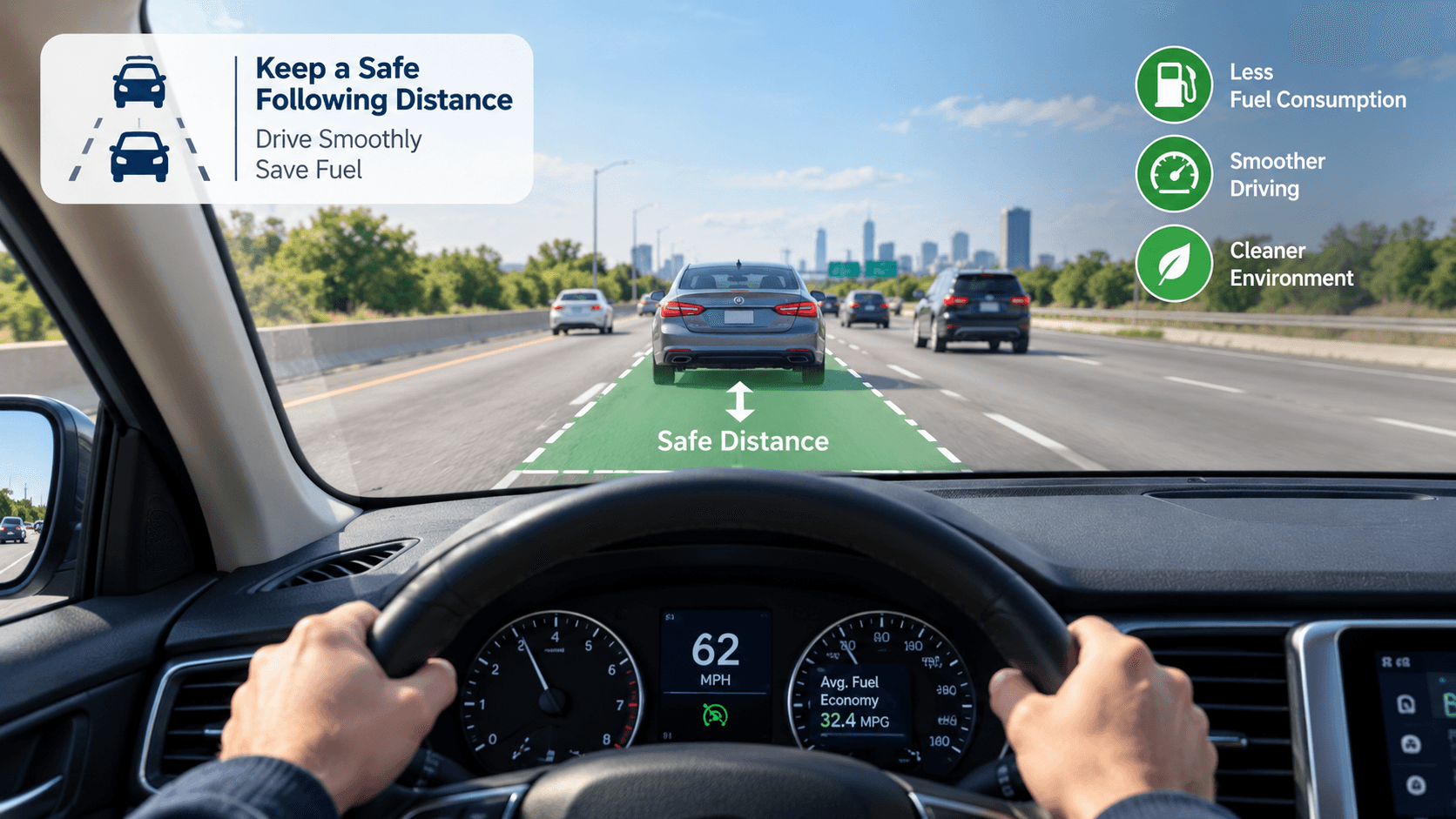
This doesn’t mean coasting in neutral or driving unpredictably. Keep the car in gear, stay in control and drive for the conditions. Smooth driving is also safer and easier on your brakes and tyres.
2. Reduce Your Speed When It Is Safe and Legal
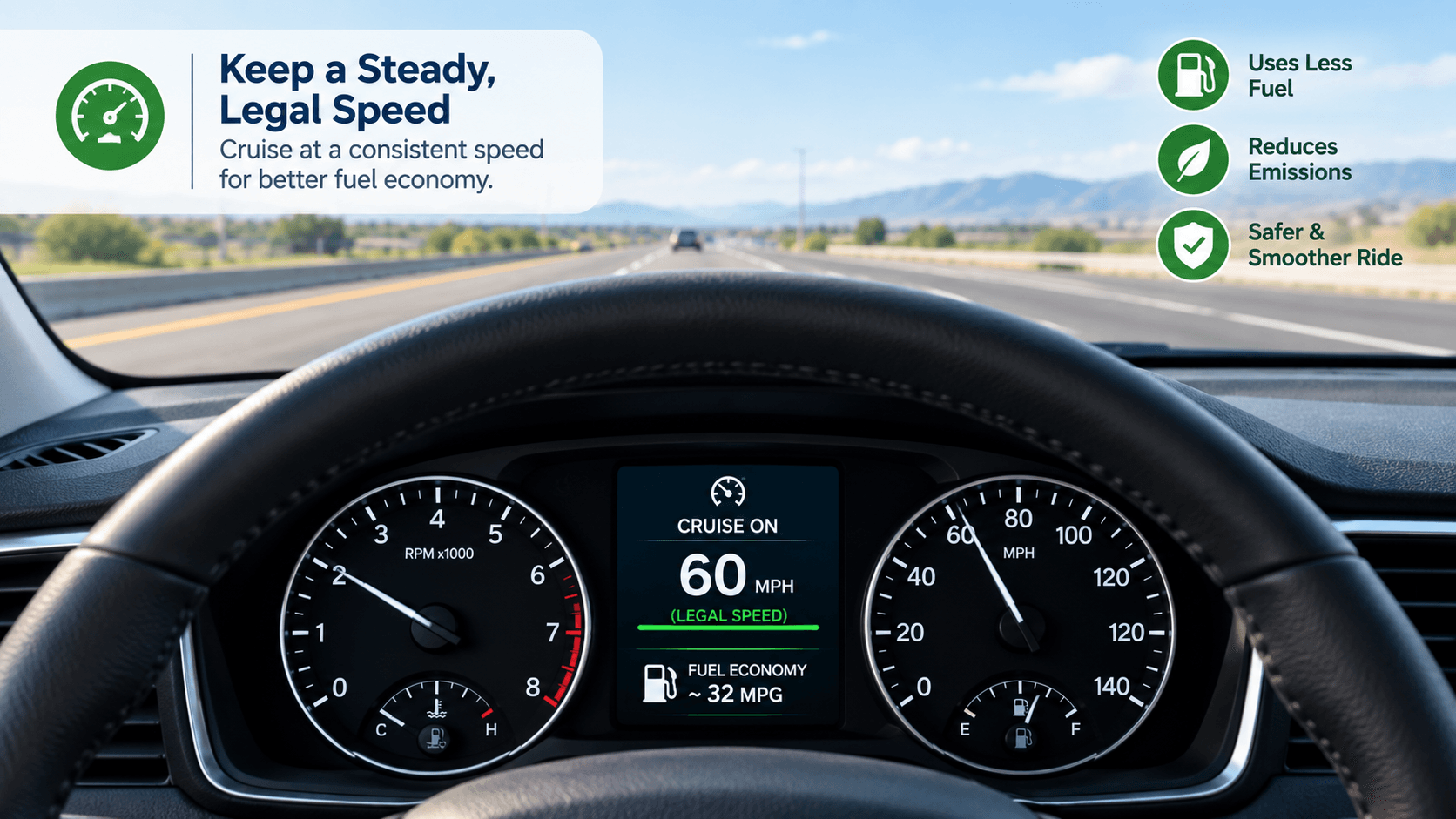
The faster you go, the more air the car has to push out of the way. Aerodynamic drag rises steeply with speed, so at motorway or highway speeds a large share of the engine’s effort goes into fighting wind resistance. The US Department of Energy notes that every vehicle has its own most efficient speed range, but gas mileage usually falls off quickly above about 50 mph (80 km/h) (source (opens in a new tab)).
In practice, that means the last few miles per hour on a long journey often cost the most fuel for the least time saved. Easing back slightly on a long trip is one of the simplest ways to improve fuel economy.
| Driving situation | Fuel-saving approach |
|---|---|
| City traffic | Anticipate stops and ease off early |
| Open road | Hold a steady legal speed |
| Motorway/highway | Avoid unnecessary high speeds; use cruise control where suitable |
| Congestion | Leave more space and avoid repeated bursts of acceleration |
3. Keep Your Tyres Properly Inflated
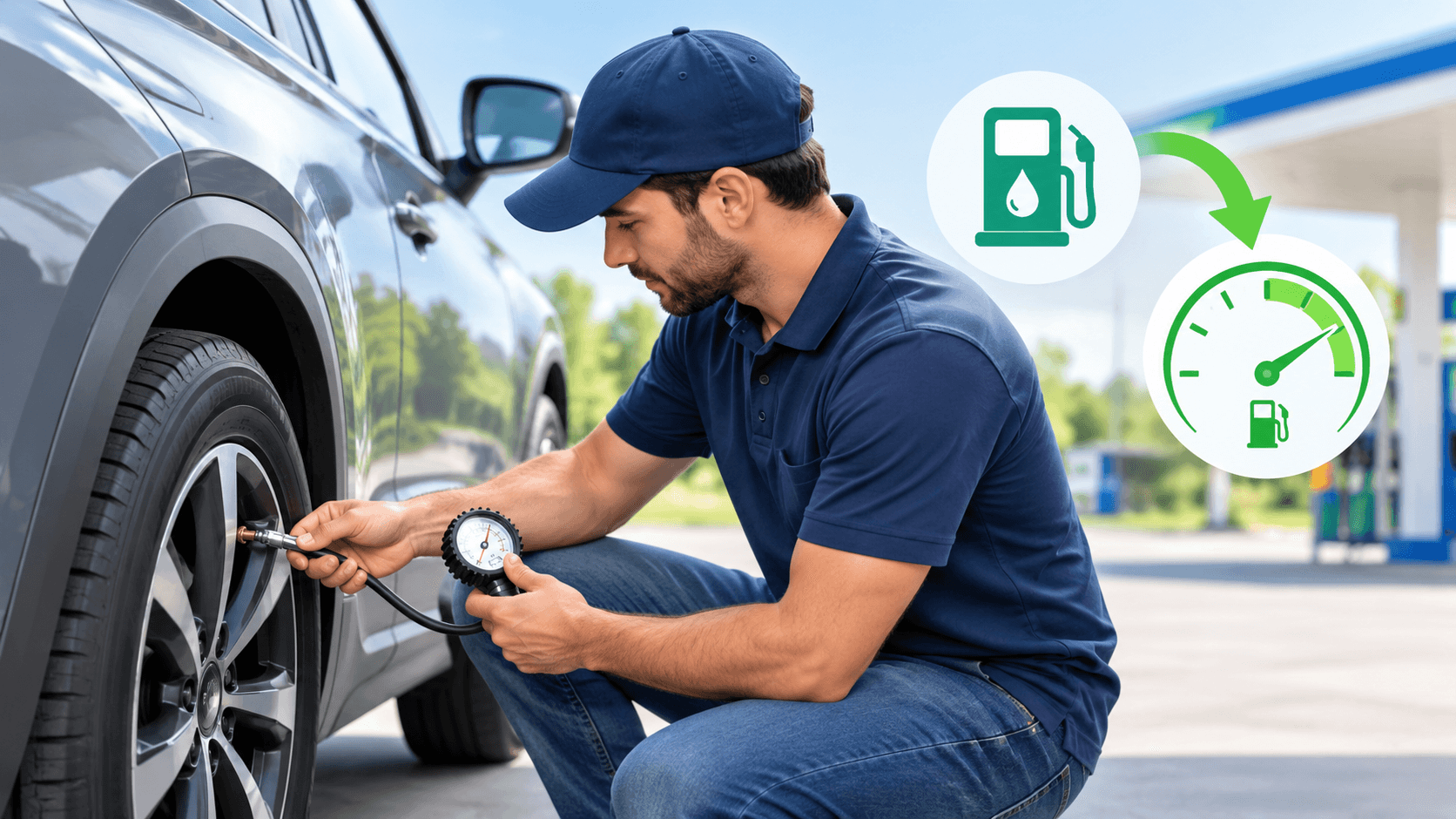
A soft tyre squashes more where it meets the road. That extra flexing creates more rolling resistance, so the engine has to work harder to keep the car moving. Under-inflation also makes handling less precise and wears the tyre edges faster.
The fuel effect of any single check is modest, but it applies to every mile you drive. FuelEconomy.gov (opens in a new tab) estimates that keeping tyres at the correct pressure improves gas mileage by around 0.6% on average and up to 3% in some cases, and the Alternative Fuels Data Center (opens in a new tab) puts the loss at about 0.2% for every 1 psi drop across all four tyres.
- Find the correct pressure in your owner’s manual or on the label usually inside the driver’s door frame, fuel filler flap or glovebox.
- Check tyres when they’re cold, before you’ve driven far.
- Check at least monthly and before long journeys.
- Use the higher “full load” pressure if your manual lists one and the car is loaded.
4. Stop Unnecessary Engine Idling
An idling engine does zero miles per gallon. It keeps burning fuel while the car goes nowhere. The US Department of Energy estimates that idling uses roughly a quarter to half a US gallon (around 1–2 litres) per hour, depending on engine size and air-conditioning use (source (opens in a new tab)).
- Switch off when you’re safely parked and waiting, for example at a school pickup.
- Let your car’s stop-start system do its job rather than disabling it by habit.
- Skip long warm-up sessions on cold mornings. Most modern engines warm up faster when driven gently (source (opens in a new tab)).

Only switch off when you’re genuinely stationary and safe. In moving traffic, at junctions or anywhere you may need to move off quickly, keep the engine running.
5. Remove Unnecessary Weight From Your Car
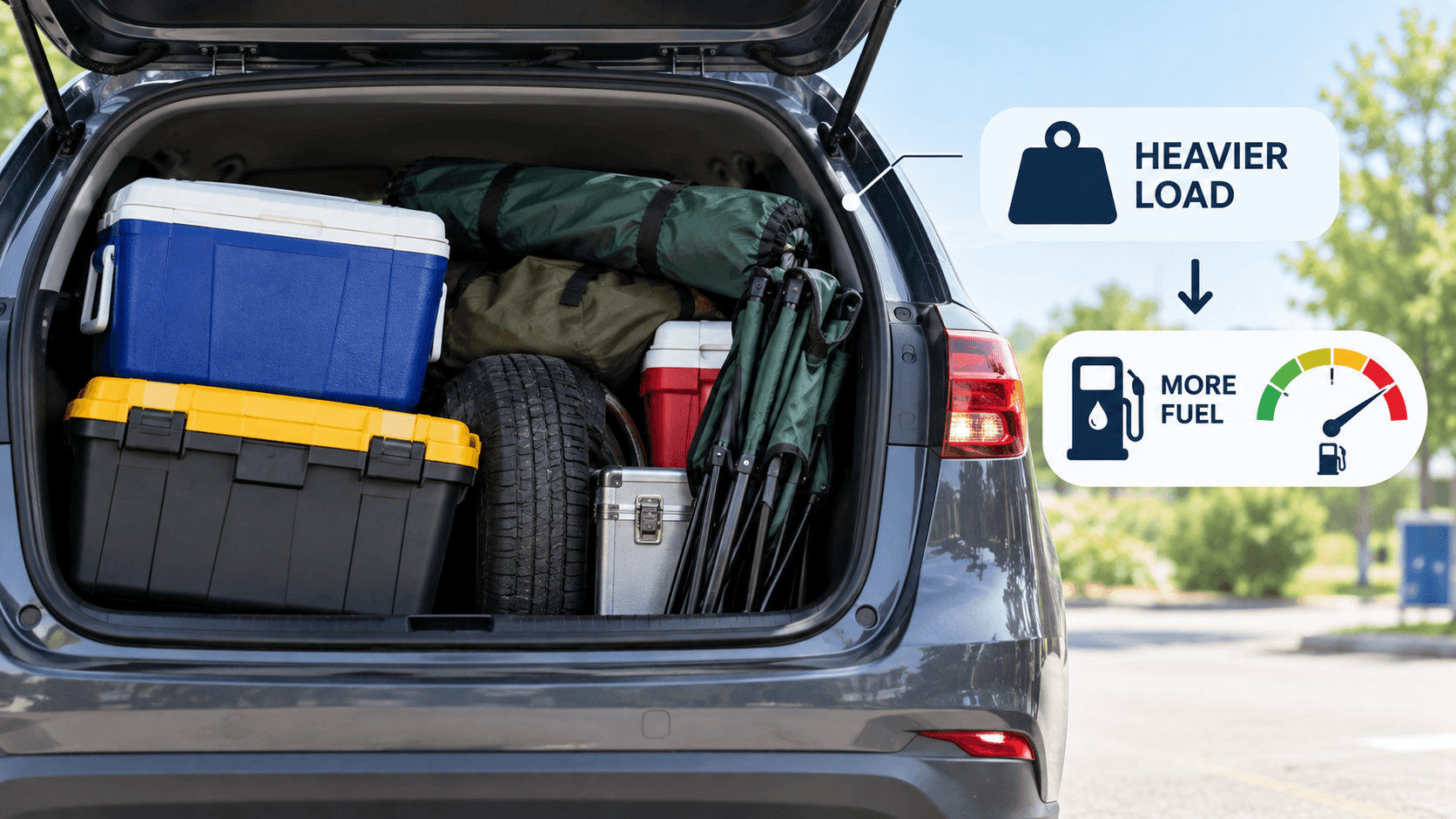
The heavier the car, the more energy it takes to get it moving, especially in stop-start driving where you’re accelerating over and over. The penalty depends on the extra weight compared with the weight of the vehicle, so it matters more in a small hatchback than in a large SUV (source (opens in a new tab)).
Most of us carry things around for months without thinking: sports kit, boxes for the recycling centre, bags of tools, a second child seat that’s rarely used. None of it weighs much on its own, but together it adds up.
- Empty the boot or trunk of anything you don’t need this week.
- Unload heavy items as soon as the job they were for is done.
- Keep safety and emergency equipment such as a spare wheel or repair kit, warning triangle, first-aid kit and winter essentials.
6. Remove Roof Racks and Boxes When You Don’t Need Them
Cars are shaped to let air flow smoothly over the roof. Anything bolted on top breaks up that airflow and adds drag, and because drag grows with speed, the penalty is biggest on fast roads.
Government testing shows how large the effect can be. A big, blunt roof-top cargo box reduced fuel economy by roughly 2–8% in city driving, 6–17% on the highway and 10–25% at 65–75 mph, while a rear-mounted box or tray had a much smaller effect (FuelEconomy.gov (opens in a new tab)). Results vary with the shape and size of the equipment and the vehicle.
| Equipment | Effect |
|---|---|
| Empty roof bars | Additional aerodynamic drag, even with nothing on them |
| Roof box | Increased drag, especially at higher speeds |
| Roof-mounted bike rack | Additional aerodynamic resistance, more so with bikes fitted |
| Rear-mounted carrier | Usually less drag than roof-mounted equipment |
| No unnecessary external equipment | Lowest aerodynamic drag |
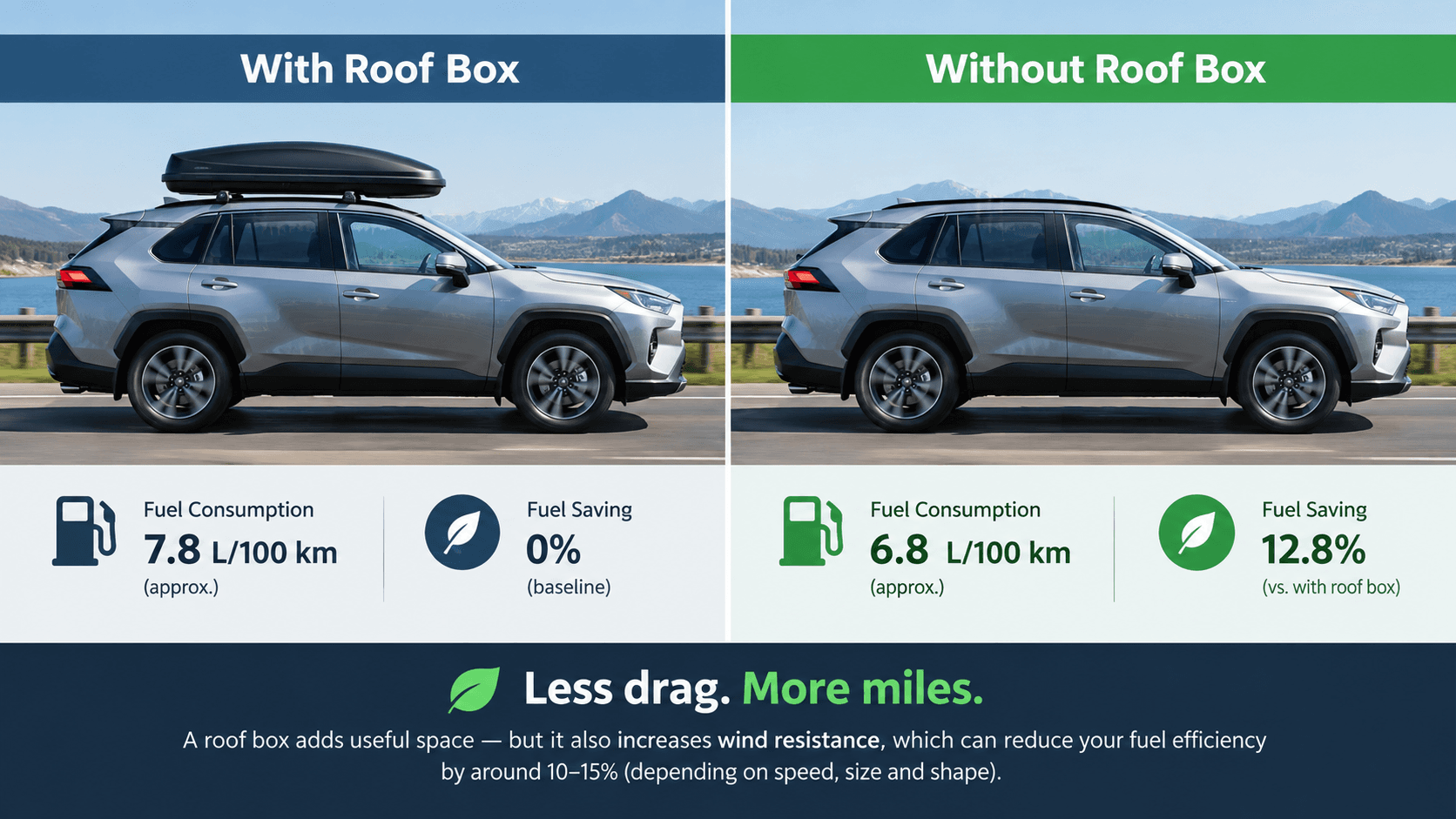
If you only use a roof box for holidays, take it off when you get home. It’s a ten-minute job that pays back on every motorway trip until the next holiday.
7. Plan Your Trips and Combine Short Journeys
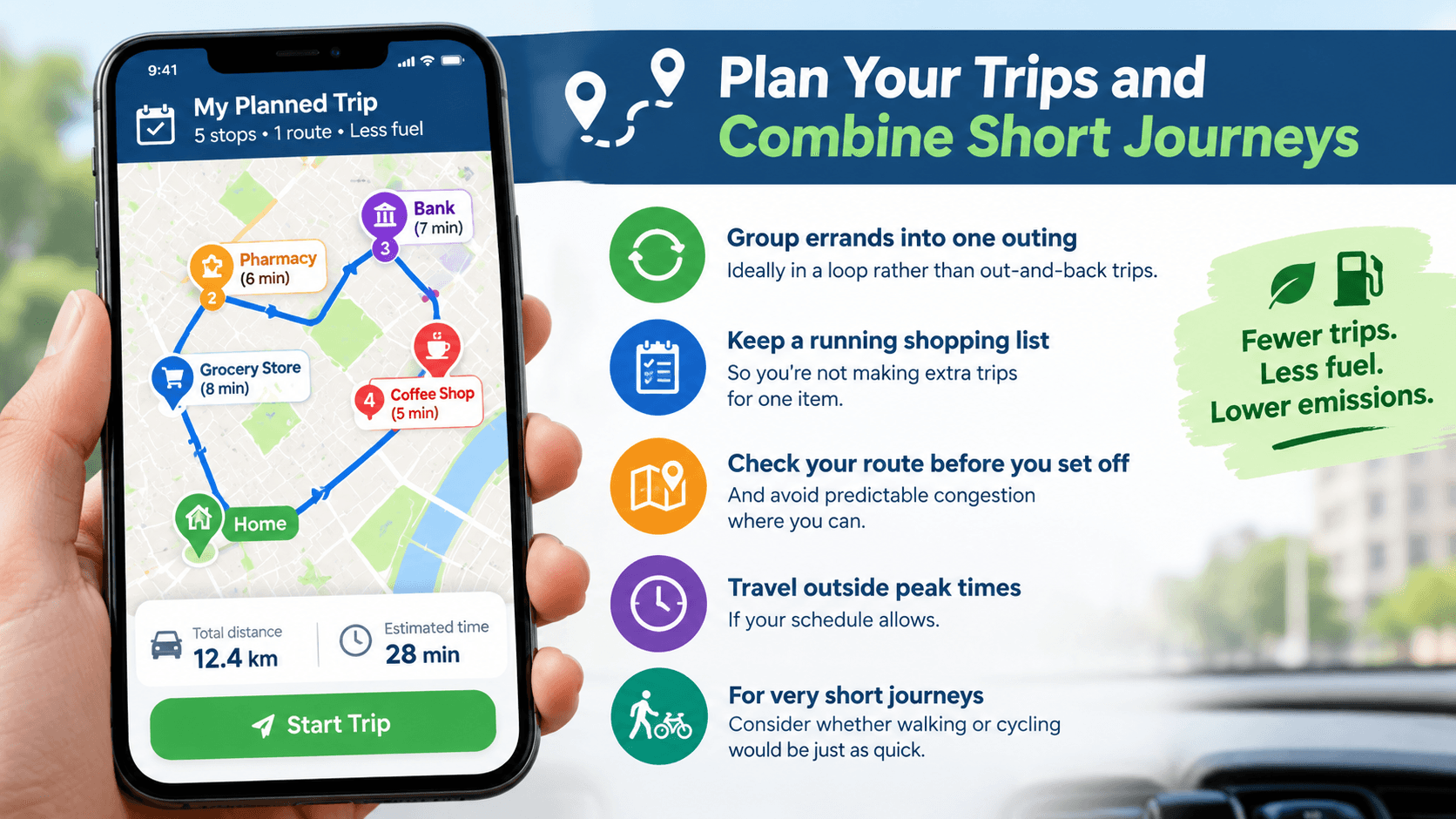
An engine is least efficient in the first few minutes after a cold start. Several short trips, each starting from cold, can use noticeably more fuel than one longer trip covering the same errands with the engine already warm (source (opens in a new tab)).
- Group errands into one outing, ideally in a loop rather than out-and-back trips.
- Keep a running shopping list so you’re not making extra trips for one item.
- Check your route before you set off and avoid predictable congestion where you can.
- Travel outside peak times if your schedule allows.
- For very short journeys, consider whether walking or cycling would be just as quick.
Before a longer trip, work out what the journey will cost with a fuel cost calculator, and compare route options with a distance calculator.
8. Maintain Your Car Properly
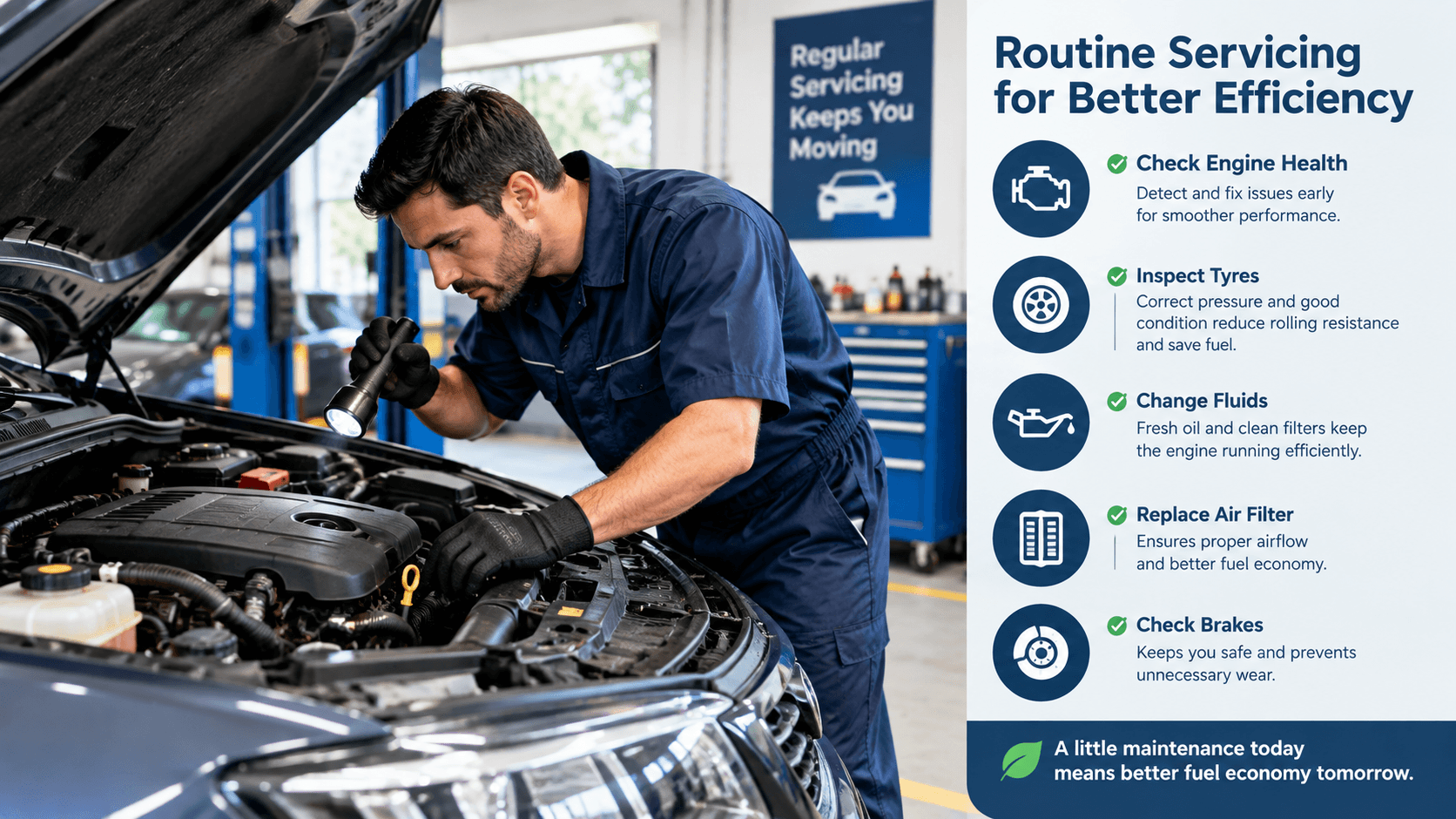
A well-maintained car doesn’t become more efficient than it was designed to be, but a car with a problem can quietly get less efficient. Fixing a real fault restores efficiency that’s been lost, and often prevents a bigger repair bill later.
Some examples from the US Department of Energy: fixing a car that is noticeably out of tune improves efficiency by around 4% on average, and switching to the manufacturer’s recommended grade of motor oil can improve gas mileage by 1–2% if the wrong grade was being used (source (opens in a new tab)).
| Maintenance item | Why it matters |
|---|---|
| Tyre pressure | Reduces unnecessary rolling resistance |
| Engine servicing | Helps the engine operate as intended |
| Correct oil | Use the manufacturer's recommended specification |
| Brake inspection | Catches problems such as a sticking brake that causes drag |
| Wheel alignment | Helps avoid abnormal tyre wear and extra rolling resistance |
| Warning lights | An engine or emissions fault can raise fuel consumption |
9. Compare Fuel Prices Before Filling Up
Everything above reduces how much fuel you use. This one reduces what you pay for it. Prices can vary noticeably between stations only a short drive apart. Motorway and highway service areas are often among the most expensive.
- Check prices with a fuel price app or website before you need to fill up.
- Don’t wait until the warning light is on. Running low removes your choice of where to buy.
- Fill up at a cheaper station that’s already on your normal route.
- Be wary of long detours: the extra driving can cancel out the saving.
Whether a detour is worth it depends on the price gap, how much fuel you’re buying and how far out of your way you have to go. Here’s a quick way to check.
Is the cheaper fuel station actually cheaper?
Compare the price saving with the fuel you burn getting there and back.
Usually your tank size minus what's left in it.
Only the detour beyond your normal route.
Worth it: you’d come out about $0.94 ahead.
- Saving from the lower price
- $1.68
- Fuel cost of the detour
- $0.74 (0.21 gal)
- Net saving
- $0.94
- Break-even detour
- 13.6 mi round trip
This counts fuel only. Your time, queues and wear on the car aren’t included.
10. Reduce Unnecessary Driving
The most reliable way to spend less on fuel is to drive fewer miles or kilometres. Every journey you don’t make saves the full cost of that journey, whatever your car’s fuel economy.
- Share lifts with colleagues or other parents where it’s practical.
- Use public transport for journeys where it’s convenient, such as into a city centre.
- Walk or cycle for short local trips when the weather and distance suit it.
- Work from home some days if your job allows.
- If your household has more than one car, use the more efficient one for everyday trips.
None of these has to be all-or-nothing. Replacing just one or two regular car journeys a week makes a measurable difference over a year.
10 Fuel-Saving Habits at a Glance
| Method | What to do | Potential benefit |
|---|---|---|
| Smooth driving | Accelerate and brake progressively | Reduces unnecessary fuel use |
| Moderate speed | Avoid unnecessary high speeds | Reduces aerodynamic losses |
| Tyre pressure | Follow the manufacturer recommendation | Reduces rolling resistance |
| Avoid idling | Turn the engine off when safely appropriate | Prevents wasted fuel |
| Remove weight | Clear out unnecessary items | Reduces vehicle load |
| Remove roof equipment | Take off unused racks and boxes | Reduces aerodynamic drag |
| Plan journeys | Combine trips and choose routes | Reduces distance and cold starts |
| Maintain vehicle | Fix problems and follow the service schedule | Helps efficiency |
| Compare fuel prices | Check nearby prices on your route | Reduces cost per litre/gallon |
| Drive less | Replace suitable trips with alternatives | Directly reduces fuel use |
How Much Money Can You Save on Fuel?
There’s no single honest answer, because potential savings vary considerably. They depend on your vehicle, how far you drive each year, your current fuel economy and fuel price, your driving style, the traffic and climate you drive in, and the condition of the car. A driver who already drives gently will gain less from smoother driving than one who doesn’t.
What you can do is see what a given improvement is worth to you. The table below uses a hypothetical driver spending $250.00 a month on fuel.
| Reduction in fuel use | Monthly saving | Yearly saving |
|---|---|---|
| 5% | $12.50 | $150.00 |
| 10% | $25.00 | $300.00 |
| 15% | $37.50 | $450.00 |
To check whether your changes are working, track your real fuel economy over a few tanks with an MPG calculator or an L/100 km calculator, then compare it with your starting point.
Common Fuel-Saving Mistakes to Avoid
Mistake 1: Driving dangerously slowly
Fuel economy should never come before road safety. Crawling well below the speed of traffic can cause frustration and risky overtaking around you. Aim for a steady, legal speed instead.
Mistake 2: Overinflating tyres
More pressure isn’t better. The figure on the tyre sidewall is a maximum, not a target. Overinflated tyres have less grip and wear unevenly, so stick to your vehicle manufacturer’s recommended pressures.
Mistake 3: Driving far out of the way for cheaper fuel
A lower price on the board isn’t a saving if you burn the difference getting there. For small price gaps, the break-even detour is often only a few miles, which is why the station calculator above is worth a quick check.
Mistake 4: Keeping the engine running unnecessarily
Waiting in a car park with the engine running, or idling for several minutes to warm up on a cold morning, burns fuel for no distance travelled.
Mistake 5: Buying products that promise huge fuel savings
Be sceptical of gadgets, magnets and additives that claim dramatic improvements. If a product can’t point to credible independent testing, the money is usually better spent on maintenance your car actually needs.
Mistake 6: Ignoring mechanical problems
A sudden drop in fuel economy can be an early warning sign of a fault, such as an underinflated tyre, a sticking brake or an engine issue. If your consumption rises without an obvious reason, or a warning light comes on, have the car checked.
How to Save Fuel in Different Driving Situations
| Situation | Useful approach |
|---|---|
| City driving | Anticipate traffic and avoid harsh acceleration |
| Highway driving | Maintain a steady legal speed |
| Heavy traffic | Avoid unnecessary acceleration and braking |
| Short trips | Combine journeys where practical |
| Long trips | Check tyres and plan the route beforehand |
| Hot weather | Use climate control sensibly and avoid unnecessary idling |
| Cold weather | Follow manufacturer guidance; avoid unnecessary warm-up idling |
| Fully loaded car | Set tyre pressures to the manufacturer's load recommendations |
Calculate Your Fuel Cost and Potential Savings
Curious what your driving currently costs you? Put in your own mileage, fuel economy and fuel price to estimate your monthly fuel cost, your annual fuel cost and how much a more efficient month could save.
Estimate your fuel savings
Estimate your current fuel cost and what a more efficient month would save you.
Change units and currency
Your trip computer or a fill-up log gives the most realistic figure.
You could save approximately $12.50 per month and $150.00 per year.
- Current monthly cost
- $125.00
- Improved monthly cost
- $112.50
- Reduction
- 10%
- Fuel used now
- 35.7 gal/month
- Fuel used after
- 32.1 gal/month
- Economy needed
- 31.1 MPG
Actual savings depend on driving conditions, vehicle condition, fuel prices and the improvement you achieve. This is an estimate, not a guarantee.
Related tools
Frequently Asked Questions About Saving Money on Fuel
What is the best way to save money on fuel?
For most drivers, the biggest win is driving more smoothly: gentle acceleration, early braking and steady speeds. After that, keep your tyres at the recommended pressure, avoid unnecessary idling, remove unused roof equipment and combine short trips. The best single change depends on how you currently drive, so start with the habit you know you do most.
Does driving slower really save fuel?
Usually, yes, within reason. Air resistance rises steeply with speed, so the engine works harder at higher speeds and fuel economy tends to fall. Every vehicle has a different most-efficient speed, though, and driving well below the flow of traffic can be unsafe. Stick to a steady speed within the limit rather than going as slowly as possible.
Does tyre pressure affect fuel consumption?
Yes. Under-inflated tyres flex more and increase rolling resistance, so the engine uses more fuel to keep the car moving. Low pressure also affects handling and tyre wear. Use the pressure your vehicle manufacturer recommends, not the maximum printed on the tyre sidewall.
Does idling waste fuel?
Yes. An idling engine burns fuel while the car covers no distance at all. How much depends on engine size and whether the air conditioning is running. When you are safely parked or waiting for more than a short time, switching off saves fuel. Never switch off in moving or stop-start traffic where you need to be ready to move.
Does air conditioning use more fuel?
Air conditioning puts an extra load on the engine, so it does increase fuel use, especially in hot weather and on short trips. At higher speeds, driving with the windows open adds aerodynamic drag, so the difference narrows. Use climate control sensibly rather than avoiding it entirely, particularly when heat could affect your concentration.
Does carrying extra weight increase fuel consumption?
Yes. The engine has to work harder to accelerate a heavier vehicle. The effect depends on the extra weight relative to the vehicle, so it matters more in smaller cars. Clearing out heavy items you rarely use is worthwhile, but keep safety and emergency equipment in the car.
Do roof racks affect fuel economy?
Yes. Roof bars, boxes and bike carriers disturb the airflow over the car and add drag, and the effect grows with speed. Even empty roof bars add some drag. If you only need roof equipment occasionally, removing it between uses is one of the easier ways to cut fuel use on longer, faster journeys.
How often should I check my tyre pressure?
A good habit is to check at least once a month and before any long journey or when carrying a heavy load. Check when the tyres are cold, before you have driven far, because pressure rises as tyres warm up. Your owner’s manual may give separate pressures for normal and fully loaded driving.
Does servicing a car improve fuel economy?
Servicing helps keep the engine and running gear working as designed, and fixing a real fault such as an out-of-tune engine, a dragging brake or incorrect oil can restore lost efficiency. A service will not make a healthy car more efficient than it was designed to be, so follow the manufacturer’s schedule rather than paying for extras you do not need.
Is it cheaper to fill the tank completely?
The price per litre or gallon is the same whether you buy a little or a lot, so a full tank is not cheaper in itself. Filling up fully can save money indirectly, because it lets you choose when and where to refuel instead of being forced to buy at an expensive station. A full tank adds a little weight, but for most cars the effect is small.
Does premium fuel improve fuel economy?
Only if your car is designed for it. Use the fuel grade or octane rating recommended in your owner’s manual. If your car is designed for regular fuel, paying for premium generally adds cost without a meaningful gain in fuel economy. If the manufacturer requires premium, using a lower grade can reduce performance and efficiency.
How can I calculate how much I spend on fuel?
Divide the distance you drive by your fuel economy to get the fuel used, then multiply by the fuel price. For example, 1,000 miles at 25 MPG uses 40 gallons, which costs $140 at $3.50 per gallon. The fuel savings calculator on this page does the conversion for MPG, L/100 km or km/L and shows what a small efficiency improvement would be worth.
Start Saving on Fuel Today
You don’t need to change everything at once. Small, consistent habits are what move the number on your fuel receipts. Here’s a simple way to start this week:
- Work out what you spend on fuel now, so you have a baseline to compare against.
- Pick two or three habits from this guide that fit the way you drive.
- Check your tyre pressures against the figure in your owner’s manual.
- Take anything heavy you don’t need out of the boot or trunk.
- Plan your next few errands as one trip.
- Track your fuel consumption over the next few fill-ups to see what changed.
Sources
- Gas Mileage Tips: Driving More Efficiently – FuelEconomy.gov (U.S. Department of Energy / EPA) (opens in a new tab)
- Gas Mileage Tips: Keeping Your Vehicle in Shape – FuelEconomy.gov (U.S. Department of Energy / EPA) (opens in a new tab)
- Factors That Affect Fuel Economy – FuelEconomy.gov (U.S. Department of Energy / EPA) (opens in a new tab)
- Vehicle Maintenance to Conserve Fuel – Alternative Fuels Data Center (U.S. Department of Energy) (opens in a new tab)
This guide gives general advice. Your vehicle’s owner’s manual takes priority for your specific car.